
You can often spot ChatGPT writing in seconds. The sentences are all the same length, the phrases are generic, and the tone feels like a corporate brochure.
The fix is not a magic “humaniser” tool. It has better instructions plus careful editing. This guide gives you 15 techniques, ready-to-use prompts, and a before-and-after example.
Why ChatGPT writing sounds robotic
- Repetitive sentence patterns. Many sentences start the same way and have the same rhythm.
- Generic phrases. Stock openers and filler transitions say little.
- No real specifics. The text explains ideas in general terms instead of concrete examples.
- Too formal. The default tone is polite and stiff, like a report.
What makes writing sound human
- Natural flow: sentences can start with “And” or “But,” and short fragments are fine.
- Varied rhythm: a mix of short and long sentences.
- Concrete examples: specific situations, numbers and details.
- Empathy: the writing acknowledges how the reader feels.
- Plain words: everyday language instead of abstract jargon.
15 techniques to make ChatGPT sound more human
1. Give it a specific persona
Tell ChatGPT who is writing and who is reading.
Write as a friendly maths teacher explaining this to a Class 9 student who finds algebra confusing.
2. Ask for conversational language
Write as if you are talking to one reader over coffee. Use “you” and keep it relaxed.
3. Ask for realistic examples
Give two examples a small bakery owner would recognise from their daily work.
4. Keep paragraphs short
Keep every paragraph to three sentences or fewer.
5. Use contractions
Ask for “it’s,” “you’ll” and “don’t” where people would say them out loud. Writing without contractions sounds stiff.
6. Ask for a clear point of view
Take a clear position on which option is better for beginners and explain why.
Check that the reasoning holds up before you publish it.
7. Open with a relatable scenario
Start with a short scenario a first-time freelancer would recognise.
Keep scenarios clearly framed as examples (“Imagine you…”), not as things that happened to you.
8. Vary sentence length
Mix short, punchy sentences with longer ones. Avoid three sentences in a row of the same length.
Read the result out loud. You will hear where the rhythm feels flat.
9. Ban corporate jargon
Negative instructions work well. Give ChatGPT a list of words and phrases to avoid.
Do not use these words: leverage, utilise, robust, seamless, unlock, delve, game-changer, in today’s fast-paced world.
10. Use questions
Include three or four questions that the reader is likely to be asking themselves.
11. Add light humour only where it fits
Add a light touch of humour only where it feels natural. Do not force jokes.
12. Acknowledge the reader’s feelings
Acknowledge that the reader may feel overwhelmed or frustrated at this step.
13. Cut repetition
Make sure every sentence adds new information. Remove anything that repeats an earlier point.
14. Edit the draft yourself
Treat every ChatGPT output as a first draft. Read it aloud, cut weak sentences, fix anything that sounds off, and add your own voice.
15. Add what only you can add
The biggest difference between generic and genuinely helpful content is real knowledge. Add your own screenshots, tested steps, real data and honest opinions.
Important: never ask ChatGPT to invent personal stories, clients, results or statistics and present them as real. Readers, Google and ad networks treat made-up experience as misleading content. If you do not have a real example, use a clearly labelled hypothetical one.
Ready-to-use prompts
For blog posts
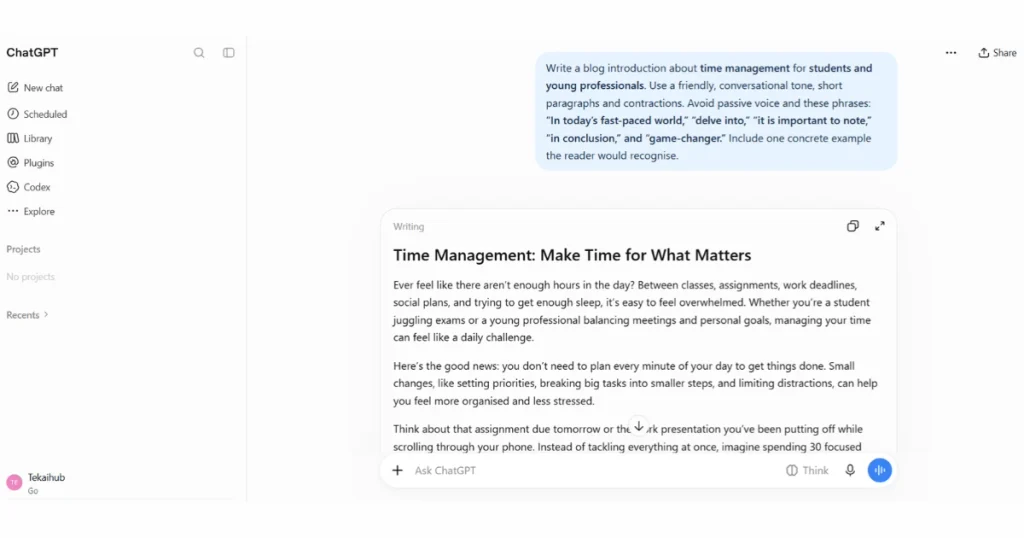
Write a blog introduction about [topic] for [audience]. Use a friendly, conversational tone, short paragraphs and contractions. Avoid passive voice and these phrases: [list]. Include one concrete example the reader would recognise.
For social media
Write an Instagram caption about [topic]. One idea per line. Sound like a real person, not a brand. End with a question that invites comments.
For emails
Write a short, warm email to [person] about [purpose]. Be direct and friendly. No stiff phrases like “I hope this email finds you well.”
For marketing copy
Write product copy for [product] focused on what the customer gets, not features. Use plain words, describe one real situation where it helps, and keep it under 100 words.
Before and after example
AI-sounding version:
In today’s fast-paced digital landscape, leveraging social media is crucial for businesses seeking to enhance their brand visibility. By utilising a robust content strategy, organisations can unlock significant engagement opportunities.
This says almost nothing. It is full of buzzwords and has no specific advice.
Human version:
Posting on Instagram three times a week won’t make you famous. But it will help the people who already like your shop remember you exist. Start with one thing: show how your product is made.
The second version is shorter, concrete, and tells the reader exactly what to do.
Mistakes to avoid
- Too much slang. Match the tone to your audience.
- Forcing humour everywhere. One light moment is enough.
- Losing professionalism. Conversational does not mean careless.
- Skipping fact-checks. ChatGPT can invent statistics and quotes. Verify every claim.
- Over-editing. Keep the parts that work; fix only what sounds off.
Tools that help
- ChatGPT custom instructions: set your default tone once, under Settings → Personalization.
- Grammar checkers such as Grammarly to catch awkward phrasing.
- Readability editors such as Hemingway Editor to flag long sentences and passive voice.
- Reading aloud: the free and most effective test.
Making AI content work for SEO
- Match search intent. Answer exactly what the searcher wants, fully.
- Add original value. Your own screenshots, tests, data and opinions.
- Cite credible sources for facts and statistics.
- Follow E-E-A-T: show real experience, expertise, authority and trustworthiness.
- Answer real questions from Google’s “People also ask” box and community forums.
Frequently asked questions
Can ChatGPT write like a human?
It can come close with good prompts and editing. Real experience, opinions and specific knowledge still need to come from you.
What is the best prompt to make ChatGPT sound natural?
Combine a persona, a conversational tone request, varied sentence lengths and a list of banned phrases.
Is humanised AI content better for SEO?
Google rewards helpful, accurate content. Editing AI drafts to add real value and clarity helps far more than simply changing the style.
How do I remove AI-sounding phrases?
Keep a list of filler phrases, search your draft for them, replace each with something specific, then read the draft aloud.
Can AI detectors spot edited content?
AI detectors are unreliable and often wrong. Focus on whether a real reader finds the content useful and trustworthy.
Should I always edit ChatGPT content before publishing?
Yes. Check every draft for accuracy, clarity and voice before it goes live.
Conclusion
You do not need special tools to make ChatGPT sound human. Give it clear instructions, ban robotic phrases, and edit every draft with your own knowledge.
Start with three techniques from this guide on your next piece. Aim for content that genuinely helps the reader, not content that only hides how it was made.